Enterprise AI ROI Calculation: The Complete Guide [2026]
70% of enterprise AI projects fail to demonstrate measurable ROI within their first year. Learn the honest calculation that survives boardroom scrutiny — with real examples.
70% of enterprise AI projects fail to demonstrate measurable ROI within their first year. The problem isn't the technology — it's that most organizations never build a proper ROI calculation before they start. They invest first and measure later, discovering halfway through that the costs they didn't account for have eaten the returns they projected.
📋 Table of Contents
What Is Enterprise AI ROI Calculation?
Enterprise AI ROI calculation is the structured process of quantifying the total value an AI initiative will deliver against its total cost of ownership — before, during, and after deployment. Unlike traditional IT ROI, AI ROI must account for probabilistic outcomes (model accuracy isn't 100%), ongoing operational costs (retraining, monitoring, drift correction), and organizational costs (change management, training, workflow redesign).
But that formula alone is insufficient. True enterprise AI ROI requires continuous optimization, ruthless transparency about hidden costs, and a measurement framework that tracks both quantitative and qualitative benefits over time.
The ROI Mirage: Why Most Calculations Fail
Many AI projects promise the moon but fail to deliver measurable value. The three most common pitfalls:
1. Hidden Data Costs
Data cleaning, integration, labeling, and ongoing maintenance are rarely budgeted for. A typical enterprise AI project spends 40–60% of its total effort on data preparation — work that doesn't appear in most ROI spreadsheets. If your calculation assumes the data is ready to use, your ROI is already inflated.
2. Change Management Blindness
The best AI model in the world produces zero ROI if nobody uses it. Projects that skip change management budget typically see 2–3x longer adoption timelines and significantly lower realized returns. Training, workflow redesign, and stakeholder communication are real costs that must appear in your TCO.
3. Model Drift Erosion
ROI isn't a one-time calculation. AI models degrade over time as data distributions shift. A model that delivers 30% cost reduction in month 1 might deliver only 8% by month 12 without monitoring and retraining. Your ROI model must include ongoing maintenance costs.
How to Build a Real AI Business Case:
- Start with a Pilot: Prove value fast and scale what works. See our AI MVP guide.
- Track Quantitative & Qualitative Benefits: Don't ignore soft wins like customer experience.
- Review ROI Regularly: Models and business needs evolve — so should your metrics.
The Enterprise AI ROI Formula — A Worked Example
A more honest formula breaks value and cost into measurable components:
Total Value = (Time Saved × Labor Rate × Transactions) + (Error Reduction × Cost Per Error) + (Revenue Uplift) + (Risk Reduction)
Total Cost = (Build) + (Data Prep) + (Infrastructure) + (Change Mgmt) + (Annual Maintenance × Years)
Example: Invoice Processing Automation
A mid-market manufacturer automates invoice classification with AI:
| Value Component | Calculation | Annual |
|---|---|---|
| Time saved | 3 min × $35/hr × 24,000 invoices | $42,000 |
| Error reduction | 6% → 1.5% × $85 × 24,000 | $9,180 |
| Total Value | $51,180/yr |
| Cost Component | Details | Amount |
|---|---|---|
| Build (one-time) | 30-day MVP + integration | $45,000 |
| Data preparation | Cleaning 2 years of invoices | $18,000 |
| Infrastructure | Cloud inference + storage | $4,800 |
| Change management | Training 12 AP staff | $8,400 |
| Ongoing maintenance | Monitoring, retraining, drift correction | $12,000/yr |
| Year 1 TCO | $88,200 | |
| Year 2+ TCO | (build costs amortized) | $25,200/yr |
Year 1 ROI: ($51,180 − $88,200) / $88,200 = −42% (investment year)
Year 2 ROI: ($51,180 − $25,200) / $25,200 = +103%
3-Year Cumulative: ($153,540 − $138,600) / $138,600 = +11% and growing
This is honest ROI math — and it's the kind of calculation that survives boardroom scrutiny because it doesn't hide the investment year loss.
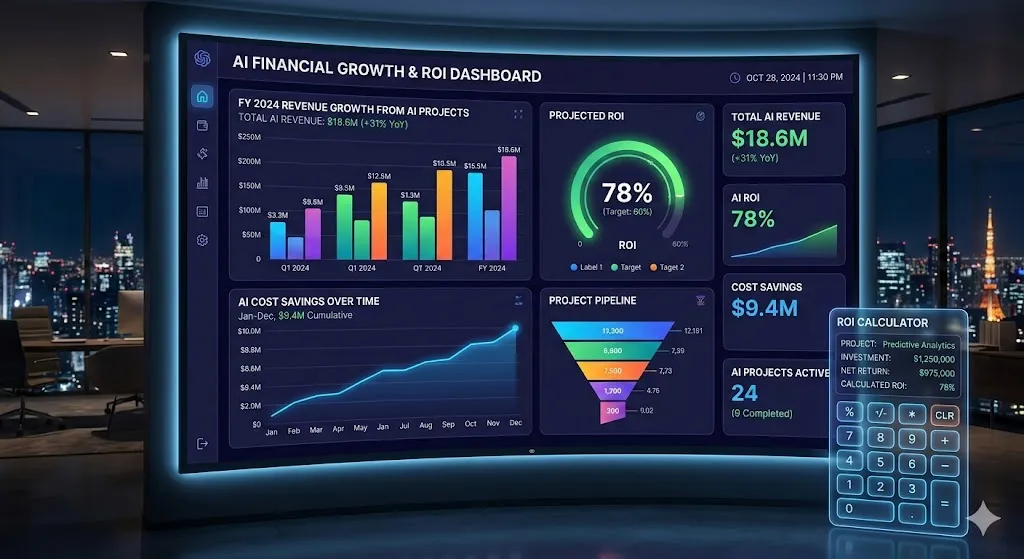
Immediate ROI Impact:
SolvIT AI's approach typically delivers measurable ROI within the first 90 days by front-loading the AI Readiness Assessment so you know exactly what you're measuring before a single line of code is written.
Hidden Costs That Break ROI Projections
- Integration tax. Connecting AI to legacy systems (ERPs, CRMs) often costs 2–3x more than estimated.
- Compliance overhead. Regulated industries need audit trails, explainability reports, and legal review — ongoing costs.
- Data pipeline fragility. Production data sources change schemas, APIs deprecate, upstream systems go down.
- Talent retention. The data scientist who built the model leaves, and nobody understands the training pipeline.
- Shadow IT sprawl. Business units procure their own AI tools, creating duplicated costs outside governance.
- Opportunity cost of delay. Every month spent building instead of validating is a month competitors gain ground.
For organizations struggling with data quality as a bottleneck, our Phase I: Diagnostic Data Governance engagement identifies and fixes these issues before they become budget-line items.
How to Build a Board-Ready AI Business Case
A CFO will shred an ROI projection that doesn't answer these five questions:
- What's the evidence this problem is worth solving? Show baseline metrics, not projections.
- What's the smallest experiment that proves or disproves the hypothesis? An AI MVP is your best defense against sunk-cost escalation.
- What assumptions are baked into the ROI, and what happens if each is wrong by 50%? Sensitivity analysis is non-negotiable.
- How do we measure success at 30, 90, and 180 days? Define the dashboard before you define the model.
- What's the kill criterion? If the model doesn't hit X accuracy by Y date, we stop. Write it down.
Real Failure Patterns (and What They Cost)
Pattern 1: The 18-Month Proof of Concept That Never Shipped
A mid-market distributor spent 18 months building an AI demand forecasting model. The data science work was excellent — but the model was trained on data from a legacy ERP being replaced, the primary business sponsor changed jobs, and no one had defined what "acceptable accuracy" meant. Estimated sunk cost: $1.4M. A proper ROI calculation with kill criteria would have killed this project at month 3.
Pattern 2: The Model That Was Right But Ignored
A healthcare provider deployed an AI triage system achieving 91% accuracy. But clinical staff had never been involved in design, didn't trust the recommendations, and routed everything manually for 8 months at full infrastructure cost. Zero operational impact, full cost. The missing line item: change management.
Pattern 3: The Pilot That Worked Until It Scaled
A logistics company's AI dispatch optimization reduced delays by 32% in a test region. National rollout crashed in 3 weeks — infrastructure wasn't provisioned, data pipelines couldn't handle volume, and model drift set in as new regions had different traffic patterns. The ROI calculation assumed linear scaling. It wasn't.
Key Takeaways
- Enterprise AI ROI calculation must account for probabilistic outcomes. Unlike ERP ROI (deterministic), AI has accuracy ranges, drift, and retraining cycles.
- The classic ROI formula is insufficient. Add data prep, change management, monitoring, and model drift to your TCO.
- Hidden costs (integration, compliance, talent, data fragility) routinely 2–3x initial projections.
- Build a board-ready business case with sensitivity analysis and kill criteria. If your ROI can't survive a 50% assumption error, it's not ready.
- Start with a pilot, prove value fast, and scale what works. An AI MVP validates the hypothesis before you commit to full build.
- Review ROI regularly. A model that delivered ROI in Q1 may be cost-negative by Q4 without monitoring.
- The cheapest AI project is the one you validate before building. A readiness assessment costs a fraction of a failed deployment.
Related reading: What Is an AI MVP? | AI Readiness Checklist | Phase I: Diagnostic Governance | Free AI Assessment
Ready to prove your AI ROI?
Get a rapid ROI assessment and build a business case that wins executive support.
Book Your Free Consultation